Better packaging by design

How collaboration cut costs on Pick n Pay’s flavoured chips range

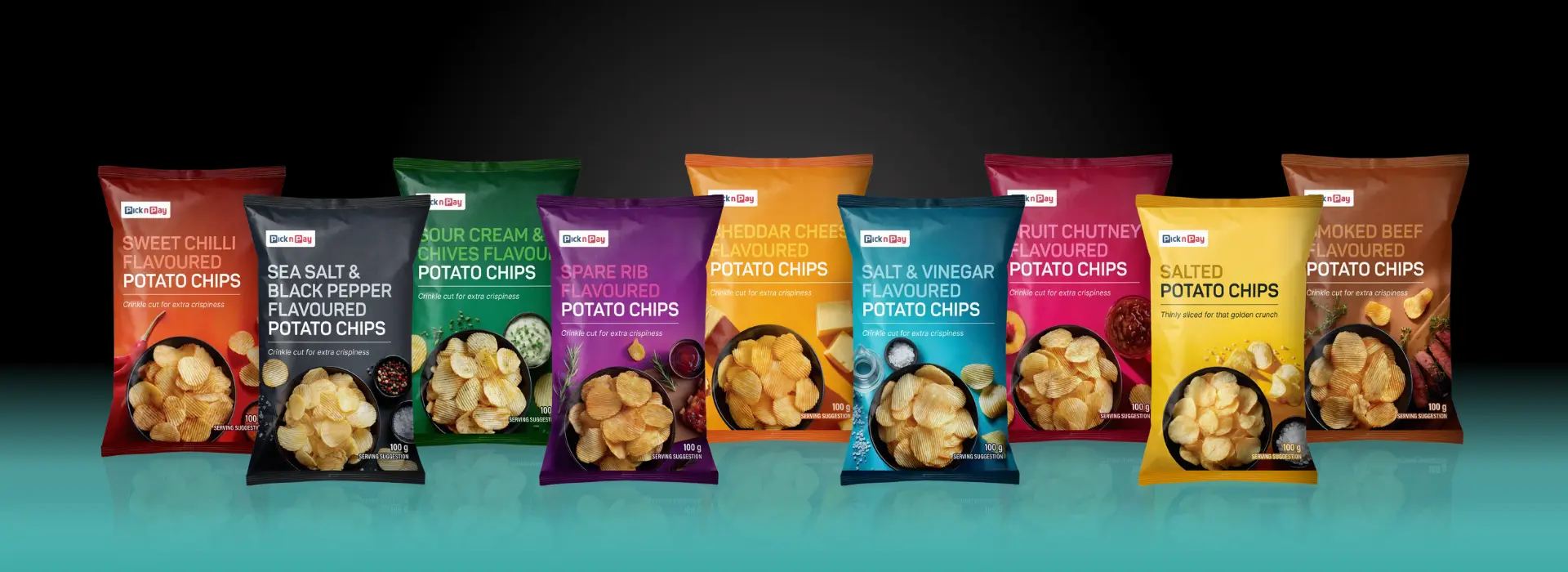
When Pick n Pay set out to refresh its Flavoured Potato Chips Range, the brief was twofold: create a stronger, more premium presence on shelf, while finding a smarter and more economical way to produce nine variants in shorter runs.

The resulting solution brought together Pick n Pay, Find, Polyflex and Flowe-Pac, combining strategic packaging design, technical premedia expertise and intelligent print planning.

That collaborative approach was recently recognised when the range was named a finalist at the 2026 Gold Pack Awards, held in Cape Town on 29 October.

Designing with print in mind

Find, the creative agency, developed the refreshed packaging within Pick n Pay’s established brand guidelines, creating a stronger visual identity across the range.

Top-down, AI-enhanced product photography helped create a realistic representation of the product, while the colour profiles were developed specifically with the eventual co-printing process in mind.

That early consideration of print requirements was critical. By taking the final print environment into account from the outset, the team could protect the creative intent while also improving the economics of producing multiple variants.

Making co-printing work harder

Eight of the nine variants were co-printed two-up on one set of plates, using CMYK together with selected spot colours. Salt & Vinegar was produced as a standalone print run.

For Polyflex, the technical challenge was to prepare the range so that different designs could run efficiently together while still delivering the colour, detail and consistency expected from a premium pack.

The team created the co-printing plates and used GMG colour-management software to replicate press conditions ahead of production and confirm that the proposed print solution was viable. Crystal plate technology was also used to control ink laydown and minimise dot gain, supporting sharper detail and more consistent colour reproduction on press.

Flowe-Pac then flexo-printed the range in eight colours on matt BOPP and metallised BOPP. This added another layer of technical complexity, as the print and substrate combination can reduce perceived image depth. Careful colour and plate control helped the finished packs deliver richer colour, sharper detail and a premium tactile feel.

Better results, on shelf and on press

The new production approach delivered significant efficiencies:

  • 75% savings in packaging costs
  • 50% savings in repro costs


Co-printing also made economical short runs possible across the range, giving Pick n Pay greater flexibility while reducing the upfront capital required to bring all nine variants to market.

The range launched in March 2026 and recorded strong early performance. After eight weeks in trade, turnover was approximately 31% higher than the previous Pick n Pay potato chip range, while unit sales increased by 38%.

Of course, commercial performance is influenced by many factors, so those gains can’t be attributed to packaging alone. However, the project demonstrates the value of approaching packaging development as one connected process rather than a series of isolated handovers.

When brand teams, designers, premedia specialists and converters collaborate early, creative intent, technical feasibility and production efficiency can be considered together.